
Articles
| Name | Author | |
|---|---|---|
| From Hotels To The High Seas: Digitizing Passenger Experience At Celestyal | Celestyal and SuitePad | View article |
| Introducing: Lufthansa Industry Solutions’ Digital Twin | Dr. Gerald Däuble, Head of LHIND Digital Twin | View article |
| Ultrabulk Realizes The Human Dividend | Oskar Fabricius, CFO at Ultrabulk | View article |
| A Shipping Business Made Savings And Improved Utilization | Amanda Aho Vanhatapio, Customer Success Manager, Seaber | View article |
| The Changing Maritime Sector | Callum Beaumont, Founder of Cordell Beaumont | View article |
| Keeping It All together For Ambassador Cruise Line | Ryan Simpson, Head of Technology, Ambassador Cruise Line | View article |
| Seacraft IT Takes To The Oceans | Ed Haskey, Director Aircraft IT | View article |
Keeping It All together For Ambassador Cruise Line
Author: Ryan Simpson, Head of Technology, Ambassador Cruise Line
Subscribe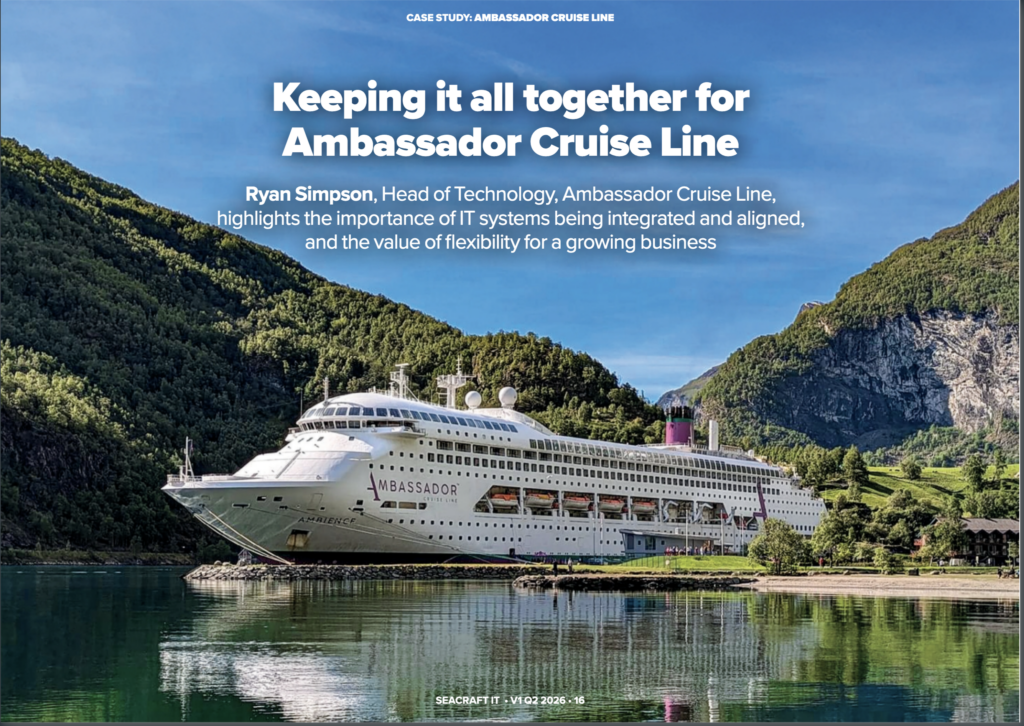
Ryan Simpson, Head of Technology, Ambassador Cruise Line highlights the importance of IT systems being integrated and aligned, and the value of flexibility for a growing business
One of the key sectors that we’ll cover in Seacraft IT is the Cruise sector. The global cruise industry is experiencing significant growth, with record-setting passenger volumes and revenue projected through 2026 and beyond. Passenger numbers are expected to grow from roughly 35 million in 2024 to 38.9 million in 2026. We wanted to know more about how Cruise companies relate to IT and what it might offer to them so we met with Ryan Simpson, Head of Technology at Ambassador Cruise Line to get the point of view from a user perspective. This article is about what Ambassador, as a cruise business, has to do, how they run their business and what they need from technology providers to add value to the business both financially and in terms of the services they offer to customers.
AMBASSADOR CRUISE LINE
We started by asking Ryan to introduce readers to the business.
Ambassador Cruise Line launched in 2021, offering the UK market authentic no-fly cruises, affordable quality and the warmest welcome at sea. We’re based in Purfleet, Essex, England, and our ships provide adult-only experiences to multiple destinations including the Nordics, Iceland, the Mediterranean, Caribbean and Africa. The cruise line’s first ship, ‘Ambience’, entered the fleet in May 2022, operating from her home port of London Tilbury. From the 2023/24 season, guests have sailed on board ‘Ambience’ as well as Ambassador’s second ship, ‘Ambition’, whose maiden voyage in May 2023 heralded the launch of sailings from seven regional UK ports: London Cruise Terminal in Tilbury, Essex, Newcastle, Dundee, Liverpool, Belfast, Bristol Royal Portbury and Portsmouth. The addition of Renaissance to the fleet following the merger of Ambassador Cruise Line and French cruise operator Compagnie Française de Croisières (CFC) in January 2025 marked the creation of a leading European affordable quality cruise line.
THE APPROACH TO DIGITALIZATION
That was the Cruise Line, now we wanted to understand how Ambassador approaches digitalization. Ryan started with a familiar comment from businesses we meet, telling us that budgets play a huge part.
We have to be conscious of where we invest and where we feel we’re going to get the most value from either return on investment (ROI) or for the guest experience. They’re the two things Ambassador focuses on. ROI could be an operational improvement or efficiency, or it could be about a revenue initiative. Regardless, the guest experience remains at the heart of what we consider when we look at digitalization. We also have to consider that our demographic is predominantly 50 plus; a lot of operators have got a younger average demographic, so their digitalization strategy will be very different to ours and likely more aggressive. We try to keep things simple, efficient and easy to access. That’s how we approach all our projects and enhancements.
ADDRESSING THE CHALLENGES OF SCALING
As a follow on from that, we asked how Ambassador deals with the challenges of scaling a cruise line as it grows. His answer started with dealing with a changing and growing business.
Our main challenge is keeping the product consistent. Having fleet wide systems allows us to stay consistent with our processes and procedures. We don’t operate multiple systems on various ships; we try to keep everything contained and we now have a well-defined blueprint for incorporating a new ship into the fleet. This also helps when we move crew between ships, or we bring crew in, for them to know how the Ambassador product and processes work. We recently did this following our merger with CFC. For the most part, they had very similar systems, which was helpful, but where there were differences: we reviewed system capabilities and migrated to the Ambassador technology stack where appropriate. This keeps it simple for everyone as we are all working the same way.
We have key partners which have become part of our business. They’re not suppliers, they are partners who help us deliver our product and goals. That’s powerful, because they know the expectations of the Ambassador guest and crew which makes it easy when we are taking on new vessels or launching new systems or enhancements.
As our business grows, we have to stay streamlined, cost effective and efficient,
which means picking the best where it’s found. We only learn by evaluating what best practice in the industry might be and adapting and changing. We focus on market trends and, like any small business, ROI. Right now, we’re focusing on AI and how we can leverage that technology to make personalized recommendations or streamline internal processes from development through to guest services. We prioritize mainly what is going to be the benefit operationally or to the customer, and ROI. Not everything falls into those three categories, but this helps us prioritize and stay aligned to the business objective. We are very agile and lean, which has allowed us to remain on a par with our competitors and in some instances surpass what they can do or offer to guests from a digital perspective. This is because we’ve been able to adapt quickly and call on our strategic partners to deliver our vision.
From that business growth perspective, we also wanted to know how Ambassador manages system and process changes and what happens to systems as the business grows.
If we’re talking about critical systems, they’re always our main priority and we will integrate where necessary with third party providers or build something in-house. Sometimes we can move a lot quicker with an integration, but other times, it’s about what could make us unique. With an off-the-shelf product, you can end up just doing what everyone else is doing or can we build something that makes us different? The cruise market is so competitive So, we do build a lot in-house to meet our specific requirements, we then have the control and the ability to adapt as we grow.
When it comes to new requirements, we review those requirements versus what functionality we have available to us right now, and can we make some quick wins just off what we’ve already got. If it’s a big strategic change, we probably have to build or buy, but for the most part, we use MVPs (Minimum Viable Products) and quick wins, because that allows us to keep moving forward while delivering value early to the business.
As we come up with new ideas or new projects come along, we identify all the potential values. It’s very easy to fall into a routine, especially in the cruise industry, where it can be difficult to change a process because we worry about what guests or trade partners might do. However, we always challenge the status quo to ensure that it’s the most optimum and our business is pretty good at wanting to change things as we as we progress.
We do come across legacy thinking, it’s expected, but we’re still a young brand, our legacy is only five years, it’s not a 20- or 30-year process that we’re trying to adapt. We might be changing something that’s only 18 months old. That allows us to keep moving forward and adapting and changing and we’ve changed a lot. We’ve changed our check-in journeys, the way people do upgrades, the way people book on our website. We’ve not been stationary; a lot has changed since we launched in 2021.
Dealing with change is clearly important for Ambassador but we wondered who influences change decisions in the business and how is the change itself managed. Ryan’s response was straightforward.
It’s competitive out there: if you don’t listen to the people buying or selling your product, you’ve got no chance. We’ve learned a lot from where we started five years ago to where we are today. The power of customer feedback, the CSQ’s (Customer Satisfaction Quotients) and trade partners, and those relationships that we build have helped us shape where we are now and where we plan to go. We like to do things differently, to look at different opportunities. We do a lot in the brand and partnership space, partnering with sports and lifestyle brands to promote our product, and environmental campaigns. All that said, our biggest thing is the personal relationship with the crew. We have a very close connection with our onboard teams, and we all share the same goal of making Ambassador successful.
Everyone is excited about growth and excited to be on board with what we’re trying to do. That close relationship helps with change management, because people trust what we’re doing when we bring them on the journey early. That’s the key you have to bring them on the journey early. The crew should never be surprised about what is coming. It shouldn’t feel like things are being imposed on them. We tell them in advance, we get their feedback, we listen to what their current challenges are and explain how this change is going to improve that. It might sound a bit clichéd but, generally, if you go on board, you will see members of Head Office staff having a coffee with the Hotel Director, going for lunch with a Guest Experience Manager, or having a meeting in a bar with the Captain, because that’s the level of relationship we’ve built, in and outside of the working environment.
Those relationships are so valuable with change management. Sometimes we have to make a decision for a commercial or a contractual reason, but we still notify the teams, keep them up to date with comms, project reports, project plans, etc. to avoid any surprises.
RISKS AND PITFALLS
Any business will, from time to time, face risks or risk pitfalls so how, we wondered, does Ambassador plan for such a possibility. Ryan explained that…
… the biggest pitfall would be to forget about the operation and the experience of the guest. It would be all too easy to overlook the context of where a system is being installed and the reason why it’s going in, and what it’s meant to deliver. Cruises are challenging operational environments with thousands of people all trying to have a great time. Anything you do, any kind of change you implement, could have a negative impact on someone’s holiday, which isn’t ideal, given the cost-of-living crisis and the fact that some people can only go on that one holiday.
When it comes to technology, the biggest pitfall is people forgetting about what it’s going to impact. We spend a lot of time thinking about the timing of changes and we’re more than happy to wait a month if it means that that date better suits the operation or the guest experience. We work closely with our partners to get their best recommendation to ensure a smooth implementation or transition. There needs to be continuity of service, even if that means challenges, the crew need to know because then they can manage that, and they’ve got time to prepare.
HOW TO MEASURE THE SUCCESS OF CHANGE
Once a change has happened, that’s not the end of the matter; it’s important to know if it has worked and, if so, to what extent. How, we asked, does Ambassador measure success?
There are several factors we consider when defining success. Revenue is, of course, important, but the most valuable insight often comes from our crew and guests. They are the first to tell us whether something is truly working. Their feedback can quickly highlight if we’ve missed the mark on a feature, or conversely, if something we might have considered minor is resonating strongly with the audience.
That insight directly influences how we prioritise future work. While we assess traditional measures such as ROI, efficiency gains, and cost savings, we also place significant weight on crew and guest feedback. They are the ones engaging with the system every day, and their experience ultimately determines its success.
Success can be defined in multiple ways. Some measures are clearly outlined in the original business case, but others go beyond that — offering a broader, more meaningful view of whether we’ve genuinely delivered value.
WORKING WITH TECHNOLOGY PARTNERS
Going back to what he’d mentioned earlier about the importance of partnerships, we asked Ryan how Ambassador determines whether they can work with a partner.
What we look for in a technology partner is genuine engagement with our business and our growth ambitions and partners who are as excited about where we’re heading as we are. We’re not looking for just another supplier, and we don’t want to be seen as just another monthly contract. We want partners who are truly invested in our success. Those are the relationships we actively build. They’re the reason we’ve been able to deploy our blueprint at pace and accelerate the growth of the Ambassador brand.
We’ve brought several new partners on board recently, and what stands out is their passion for helping us succeed. We value partners who will engage with us openly, challenge us, offer best practice, and learn alongside us. A willingness to collaborate on proof of concepts and innovate together is essential.
We’re not interested in purely transactional relationships. We’re looking for committed, collaborative partnerships that help us move forward with confidence and speed.
INTEGRATION OF SYSTEMS
For any business today using various systems in running the business, integration is a growing issue. That, we felt, puts it right on Ryan’s desk so, what is his take?
Integrating our systems is super important. We first need to make sure we’ve got clear API (Application Programming Interface) documentation and, where possible, leverage existing partner relationships so that we can move quickly and with less investment. We don’t’ have any systems that we don’t feel comfortable integrating with; that would be a major blocker for us, and we wouldn’t go down that route if we felt the system wasn’t going to be adding value to our existing architecture.
It’s super important because, as our business scales up, we need to make sure that strategic systems have access to the data requirements needed to support the service that we’re trying to provide. It’s even more important in the world of AI. AI models rely on large volumes of high-quality, real-time data. That data typically sits across multiple systems from CRM, finance, and operations to booking platforms, mobile apps etc. Without integrations, AI only sees a fragment of the picture. With integrations, AI can analyse the full ecosystem and generate meaningful insight.
UNTAPPED POTENTIAL
Ambassador is making significant and productive use of technology and IT solutions but are there any areas where even more could be achieved. Ryan thought there were.
We often limit ourselves to just thinking about cruise specific systems and suppliers within the cruise industry. We can now look at any SaaS platform that operates in the hotel or travel space because onboard connectivity is now getting better and more consistent than ever before. We’re no longer solely reliant on systems having to be operational on board and synchronizing to a shoreside environment. Ships can connect with cloud-based environments thanks to the advances in connectivity. We can now consider suppliers that don’t have the legacy of having an on-ship system and that’s quite exciting for us and for suppliers and partners, who have not previously operated in the cruise space; there’s no reason why they can’t promote their product within the cruise or wider maritime industry.
LOOKING TO THE FUTURE
We closed our meeting asking Ryan about the future: the digital future and the wider future for the sector.
Digital is and has always been the focus; everything that we do revolves around technology enhancements, new systems, integrations, functionality, and different ways of thinking. It’s going to shape our operation over the next three to five years, and beyond and will be key because, again, it’s a competitive market. So how do we differentiate ourselves? The only way to do that is by offering services and personalization to the customer so that they can engage with us in the way that they feel is the most appropriate. I think giving people choice is key, and that’s what we’re focusing on at the moment; how do we allow guests to personalize their experience on board as quickly as possible and how do we make people feel part of the Ambassador brand throughout the digital journey.
For me, the future is about choosing IT partners who share your ambition and passion for growing the brand. That alignment makes everything easier. You want partners with a start-up mindset, bringing fresh ideas, new thinking, and a collaborative approach. As you scale, those partnerships become even more important in strengthening your capabilities. It won’t always be easy for either side, but success comes from working as one team. It’s never about “us and them” or blaming suppliers. We don’t work that way. We believe in shared ownership, mutual support, and building success together.
Comments (0)
There are currently no comments about this article.
To post a comment, please login or subscribe.