
Articles
| Name | Author | |
|---|---|---|
| From Hotels To The High Seas: Digitizing Passenger Experience At Celestyal | Celestyal and SuitePad | View article |
| Introducing: Lufthansa Industry Solutions’ Digital Twin | Dr. Gerald Däuble, Head of LHIND Digital Twin | View article |
| Ultrabulk Realizes The Human Dividend | Oskar Fabricius, CFO at Ultrabulk | View article |
| A Shipping Business Made Savings And Improved Utilization | Amanda Aho Vanhatapio, Customer Success Manager, Seaber | View article |
| The Changing Maritime Sector | Callum Beaumont, Founder of Cordell Beaumont | View article |
| Keeping It All together For Ambassador Cruise Line | Ryan Simpson, Head of Technology, Ambassador Cruise Line | View article |
| Seacraft IT Takes To The Oceans | Ed Haskey, Director Aircraft IT | View article |
The Changing Maritime Sector
Author: Callum Beaumont, Founder of Cordell Beaumont
Subscribe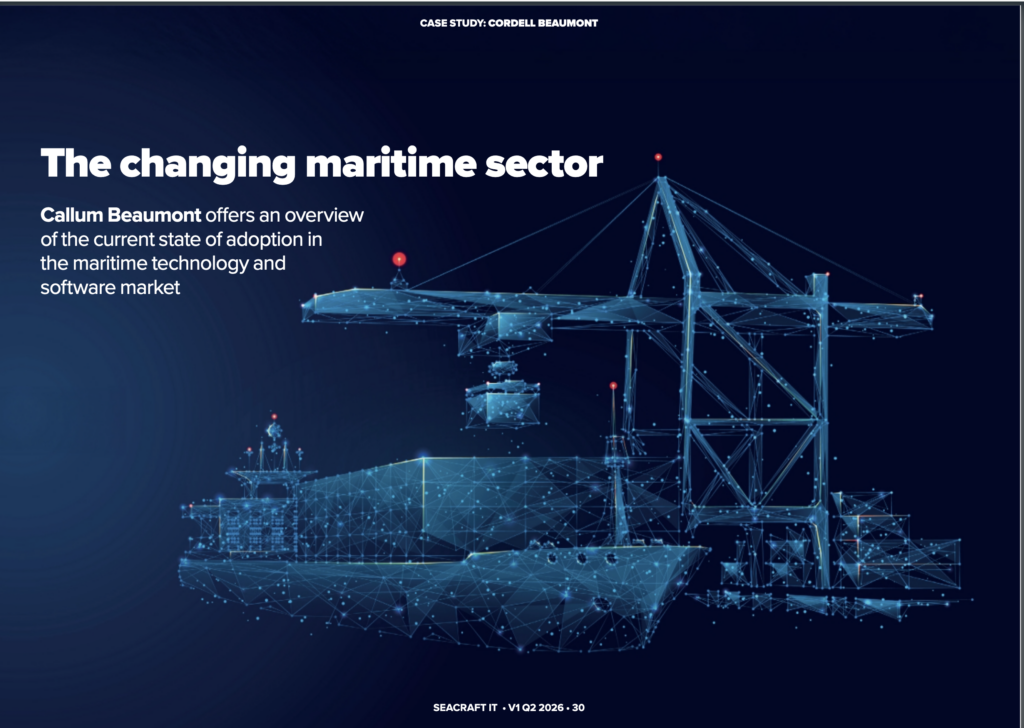
Callum Beaumont offers an overview of the current state of adoption in the maritime technology and software market
While the maritime and shipping sector has always adopted new technologies and continues to advance into digital systems and AI, the industry remains fundamentally people driven. Relationships, judgement, and commercial understanding still sit at the center of how decisions are made. The challenge is not simply technology adoption but finding the right individuals who can identify where change is needed, understand operational realities, and connect business needs with the right solutions.
In this first issue of Seacraft IT, we invited Callum Beaumont of Cordell Beaumont to explore recruitment, skills evolution, and the changing dynamics of the maritime technology sector.
SeacraftIT
I’d like to begin by introducing Cordell Beaumont, which I founded as a specialist recruitment agency focused on technology and commercial roles across maritime software, carbon intelligence, and commodity insights.
CORDELL BEAUMONT
We work closely with founders, investors, and commercial leaders to help build teams that can scale responsibly in a traditionally relationship driven industry.
Many of the professionals we support move into sales focused roles. While those roles are often associated with growth, the reality is that they frequently act as catalysts for operational and organizational change. The responsibility for long-term adoption may sit with customer success teams, but effective commercial professionals must still understand the impact their solutions have on the businesses they serve.
I originally entered the sector as a ship broker, following a family tradition. My grandfather spent nearly 60 years in shipbroking, which gave me early exposure to the mindset of shipowners, principals, and the wider commercial shipping environment. Europe remains a major hub for maritime technology and software, but the ecosystem is now truly global, with strong and growing centers in North America, Singapore, and the Middle East. We regularly support searches across these markets, supported by our teams in Florida, Texas, and London.
I spend a significant amount of time speaking with founders, commercial leaders, and investors across maritime and trade technology. That combination of shipbroking experience and talent acquisition provides a useful vantage point, allowing me to observe how software businesses are evolving, where they are investing in people, and how they are responding to shifts in buyer behaviour across the industry.
THE CHANGING MARITIME SOFTWARE LANDSCAPE
Many longstanding shipowners and principals are now actively adopting technology, while newer entrants to the industry have grown up alongside digital systems and software driven tools. As these individuals increasingly move into decision making roles, the industry as a whole is becoming more familiar with technology and, importantly, more receptive to change.
From the perspective of recruiting in commercial shipping since 2012, and maritime software more specifically since 2015, I have observed a clear shift in how companies approach growth. There has been a noticeable move towards more flexible working models to attract high quality technical talent. Commercial teams, however, still tend to require strong sector experience, reflecting the relationship driven and highly specialized nature of the end user market. Scaling today is less about speed at all costs and more about building credibility, trust, and sustainable growth.
The introduction of new technology increasingly presents opportunities to rethink processes rather than simply accelerate existing ones. This helps explain the growing importance of roles such as customer success managers and account managers, whose function is to ensure that end users realize measurable value from the solutions they adopt. These roles have become increasingly significant from both an operational and a commercial perspective.
THE RIGHT PEOPLE FOR THE JOB
Many shipowners and operators still do not have dedicated technology or software specialists internally. While this is gradually changing, responsibility for evaluating new solutions often sits with technical or operational leaders, who must then communicate the value and implications of technology investments to commercial decision makers. Successful adoption typically requires clear internal sponsorship and early alignment. This dynamic directly influences the types of professionals software vendors must recruit. Early growth often prioritizes new business focused commercial profiles, but long-term success depends equally on individuals who can drive adoption, articulate value, and support behavioral change within client organizations.
Without strong domain knowledge, companies frequently underestimate the time required to build traction and credibility in commercial shipping. Long sales cycles, relationship driven decision making, and deeply ingrained operating practices require patience and industry understanding. This is particularly relevant as investment continues to flow into maritime technology from outside the sector. The most common challenge for businesses entering the market is not technological capability but aligning commercial strategy with the realities of the industry. Sustainable success requires maritime market insight embedded not only in the product, but across sales, customer success, and leadership teams.
MOVING FROM EARLY TRACTION INTO SCALE
Moving from early traction into scale presents a different set of challenges for growing software businesses. Alignment becomes critical. As teams expand, sales, product, and leadership must remain closely coordinated around who the customer truly is and how value is delivered. Without this, messaging fragments, expectations drift, and growth can stall. One of the most effective ways to maintain alignment is through continuous customer engagement. Thorough needs assessments and structured feedback loops help ensure that insights from end users are consistently translated into product development, commercial strategy, and market positioning. While it is rarely practical to customize solutions for every individual client, successful organizations are those that systematically capture, interpret, and communicate feedback from the field. Ultimately, scale is sustained not simply by adding customers, but by ensuring the product continues to deliver meaningful and measurable value.
HOW THE MARINE IT MARKET IS EVOLVING
Buyers today are significantly more informed and selective. There is a growing emphasis on transparency, data security, and interoperability, with operators increasingly favoring a smaller number of trusted solutions that integrate effectively rather than multiple disconnected point solutions.
While regulatory frameworks around data sharing continue to evolve, organizations such as the International Maritime Organization and classification societies have played an important role in elevating the importance of cyber security. Compared with a decade ago, shipowners and operators are generally more comfortable engaging with digital platforms, although concerns around commercially sensitive data remain a defining characteristic of the sector.
From an operational perspective, voyage management, efficiency optimization, emissions monitoring, and fuel performance continue to drive technology adoption. Regulatory developments, particularly within Europe, have accelerated interest in solutions related to emissions management and bunker monitoring. More broadly, we continue to see strong demand for technologies focused on weather, routing, and decision support tools, reflecting the industry’s ongoing priorities around efficiency, safety, and cost optimization.
BUYING DECISION MAKERS
Buying decisions within maritime technology vary significantly depending on organizational structure and scale. While executive leadership often retains final authority, successful adoption typically requires alignment across commercial, operational, and technical stakeholders. Without this broader buy in, even well selected solutions can struggle to gain traction. Successful vendors recognize that securing a contract and driving internal adoption are fundamentally different challenges. One of the most underestimated factors in technology selection remains internal change management. The ability of teams to trust, use, and embed new systems into daily workflows frequently determines whether an initiative succeeds or fails.
Buyers increasingly assess potential partners through credibility and domain understanding. Industry reputation, visibility within respected networks, pilot capabilities, and peer referrals play an important role alongside technological capability. Operators seek evidence that vendors understand commercial realities, not simply technical functionality. For software businesses scaling within the sector, clarity of positioning is essential. Defining the target customer, articulating the problem being solved, and maintaining alignment across product, commercial, and marketing functions creates the foundation for sustainable growth. Interoperability and data strategy are becoming critical differentiators, reinforcing the importance of solutions that integrate effectively and deliver trusted, actionable insight.
Maritime software remains a developing market. Long term success will favor organizations that balance technological innovation with a deep understanding of industry dynamics and operating practices.
LOOKING AHEAD
While maritime technology continues to evolve rapidly, the market itself remains at a relatively early stage of maturity. Over the next three to five years, consolidation, greater platform integration, and increasingly disciplined growth strategies are likely to shape the competitive landscape. Demand will continue to favor professionals capable of bridging maritime domain knowledge with modern technology expertise and strong commercial execution. In particular, we see sustained need for new business focused commercial profiles, reflecting the ongoing emphasis on market expansion and customer acquisition.
The solutions we support span a broad spectrum, from commodity and market intelligence platforms through to operational and vessel focused software designed to improve efficiency, safety, and emissions performance. This diversity highlights both the complexity of the sector and the growing role of technology in shaping how maritime businesses operate and compete.
Comments (0)
There are currently no comments about this article.
To post a comment, please login or subscribe.