
Articles
| Name | Author | |
|---|---|---|
| From Hotels To The High Seas: Digitizing Passenger Experience At Celestyal | Celestyal and SuitePad | View article |
| Introducing: Lufthansa Industry Solutions’ Digital Twin | Dr. Gerald Däuble, Head of LHIND Digital Twin | View article |
| Ultrabulk Realizes The Human Dividend | Oskar Fabricius, CFO at Ultrabulk | View article |
| A Shipping Business Made Savings And Improved Utilization | Amanda Aho Vanhatapio, Customer Success Manager, Seaber | View article |
| The Changing Maritime Sector | Callum Beaumont, Founder of Cordell Beaumont | View article |
| Keeping It All together For Ambassador Cruise Line | Ryan Simpson, Head of Technology, Ambassador Cruise Line | View article |
| Seacraft IT Takes To The Oceans | Ed Haskey, Director Aircraft IT | View article |
From Hotels To The High Seas: Digitizing Passenger Experience At Celestyal
Author: Celestyal and SuitePad
Subscribe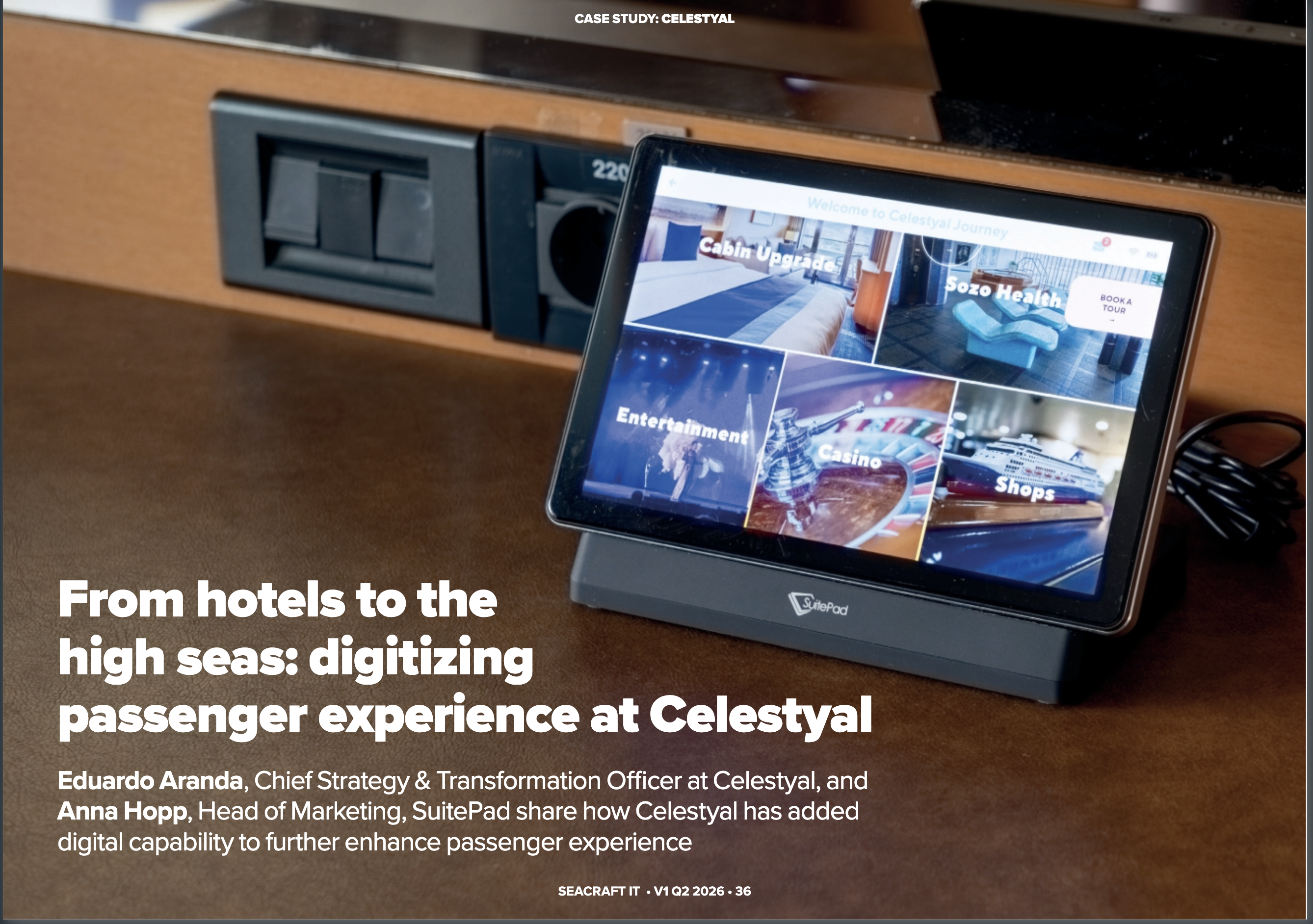
Celestyal and Anna Hopp, Head of Marketing at SuitePad share how Celestyal has added digital capability to further enhance passenger experience
As the cruise industry grows and as ships get ever larger, the logistical challenge of managing the passenger’s cruise experience has become ever more complex. Celestyal has implemented digital technology to ensure that cruise managers have the best tool to hand and, most importantly, that passengers enjoy their best vacation, not missing any opportunities or experiences they might want to enjoy.
THE CHALLENGE OF COMPLEXITY AT SEA
A modern cruise ship is far more than a means of transport. It is a floating hotel, a leisure destination, and an entertainment venue, all operating simultaneously. Thousands of passengers, dozens of daily activities, multiple restaurants, shore excursions, shows, and services must all be coordinated and communicated clearly, often across several languages. Behind the scenes, this complexity has traditionally been managed through printed programs, daily schedules, flyers, and last-minute notices, materials that must be updated constantly and distributed across the ship.
While this paper-based approach has long been the industry standard, it is increasingly at odds with both operational efficiency and guest expectations. Passengers expect information to be accessible instantly, updates to be accurate, and services to be easy to discover and book. At the same time, cruise operators are under pressure to reduce waste, streamline workflows, and create more engaging onboard experiences. It is within this environment that digital guest communication becomes not just helpful, but essential.
WHAT SUITEPAD DOES: FROM GUEST DIRECTORY TO GUEST PLATFORM
Founded in 2012, SuitePad set out to digitize a familiar element of the hotel room: the traditional guest directory. What was once a leather-bound collection of printed pages, listing restaurant opening times, menus, leisure facilities, or spa booking details, became a single, digital point of access for essential hotel information. From the very beginning, however, the SuitePad tablets were designed with evolution in mind. What started as a digital information directory quickly developed into a flexible, in-room platform that adapts to changing guest expectations and hotel operations.
Today, the SuitePad in-room tablet goes far beyond static content. It acts as a central interaction hub within the room: replacing the TV remote and the room phone, enabling guests to book room service and amenities, and allowing them to manage housekeeping preferences through SuitePad’s Green Option, the digital alternative to traditional door hangers. With just a few taps, guests can access services, manage their stay, and interact with the hotel on their own terms, while hotel teams benefit from streamlined processes and reduced operational friction.
From hotels to cruise ships: a strategic next step
Having established a leading position in the hotel sector, it became apparent that the SuitePad platform could deliver similar value for cruise ships. In many ways, cruise vessels amplify the challenges that hotels face: higher guest density, more frequent schedule changes, and a broader range of services competing for attention. On larger cruise ships in particular, managing passenger services and activities involves a significant amount of paperwork. Daily programs listing shows, tours, dining options, and onboard events must be printed, distributed, and often reprinted when schedules change. This process consumes time, resources, and paper, while still leaving room for miscommunication. SuitePad addresses this challenge by centralizing onboard information in a digital format that can be updated daily or even hourly. Activity schedules, availability, and last-minute changes can be managed centrally and communicated instantly, reducing manual effort for crew members and improving clarity for passengers.
For a long time, however, one factor limited the adoption of in-room digital solutions at sea: internet connectivity. Unlike hotels, cruise ships operate in environments where stable and consistent connectivity was historically difficult to achieve. Without reliable onboard internet, the full potential of real-time updates and digital guest communication could not be realized. Only in recent years – through the rollout of more stable satellite internet solutions – has this barrier been effectively removed, creating the technical foundation required for scalable, reliable digital guest engagement at sea.
The strategic expansion into the cruise market was further reinforced by the opening of SuitePad’s Florida office. As a global hub for the cruise industry, Florida is home to many of the world’s leading cruise operators and serves as a natural base for closer collaboration with cruise lines. The move reflects a deliberate commitment to the cruise sector; placing SuitePad closer to the operational realities, decision-makers, and long-term development needs of the industry.
CELESTYAL: BRINGING STRUCTURE, ENGAGEMENT, AND REVENUE TOGETHER AT SEA
For Celestyal, the decision to introduce SuitePad was driven by the very practical challenge as mentioned above: managing complexity in an environment where information changes daily, and sometimes hourly. With a wide range of excursions, onboard activities, dining options, and shows, keeping guests informed traditionally meant producing large volumes of printed material. Daily programs, flyers, and updates were essential, but also time-consuming, costly, and difficult to keep fully up to date.
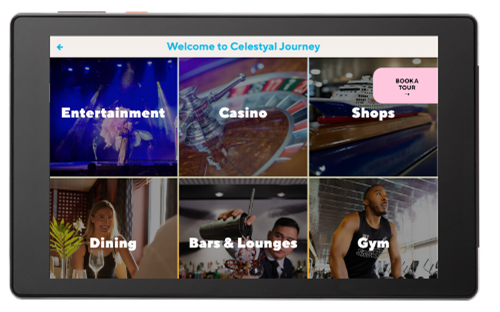
Celestyal was looking for a way to reduce this reliance on paper while giving guests a clearer, more engaging way to plan their day. The SuitePad in-room tablet offered a central digital touchpoint, directly in the cabin, where schedules, activities, and services could be updated in real time and accessed whenever guests needed them.
Enhancing the Passenger Experience Through Clarity and Access :
A cruise is not just a journey from one port to another; it is a complete holiday experience, with the ship itself acting as the primary venue. For Celestyal, this meant ensuring that guests could easily discover what was happening onboard and ashore, without feeling overwhelmed or missing opportunities.
With SuitePad installed in the cabins, passengers began using the tablet as a natural part of their daily routine: checking the program in the morning, browsing excursions before arrival at the next destination, or exploring onboard services during quieter moments. Rather than replacing personal interaction, the tablet supported it, answering routine questions and allowing crew members to focus on more meaningful guest engagement.
UPSELLING AT SEA: VISIBILITY WHERE IT MATTERS MOST
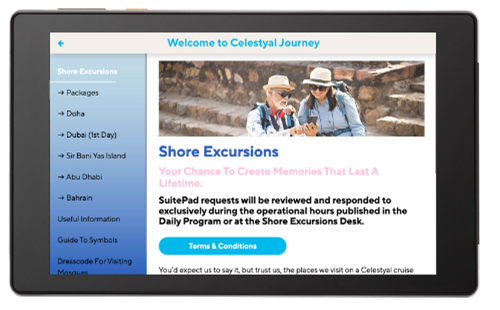
One of the clearest differences between hotels and cruise ships lies in how and where upselling happens. On a cruise, guests are immersed in a closed ecosystem for several days or weeks. They are not choosing between on-property and off-property options; instead, they are deciding how to make the most of the experiences available to them. For Celestyal, this made excursions, tours, and onboard activities particularly important. SuitePad increased visibility for these offerings by presenting them directly in the cabin, where guests have the time and space to explore options at their own pace. This approach supports discovery rather than pressure, encouraging guests to engage with the content when it is most relevant to them.
Beyond excursions, SuitePad also enables promotion of exclusive dining options, onboard services, and additional offerings that fall outside all-inclusive packages. Even on cruises where much is included, there are always experiences that guests are willing to purchase on top, especially on longer journeys.
SIMILAR FOUNDATIONS, DIFFERENT PRIORITIES THAN HOTELS
While many of the underlying requirements for digital guest communication, such as multilingual content, centralized updates, and self-service access, are similar to hotels, the priorities at sea differ in key ways. For Celestyal, features like digital housekeeping preferences were less critical, as housekeeping teams are already fully embedded onboard. Instead, the strongest value lay in areas such as excursions, daily activities, and onboard services, elements that define the cruise experience itself.
Longer guest stays also change behavior. With passengers onboard for a week or more, communication needs to remain relevant throughout the journey, adapting to destinations, weather conditions, and evolving guest interests. SuitePad’s flexibility allows Celestyal to focus on the features that matter most, without overloading the experience.
TECHNOLOGY AT SEA: INTEGRATION AND OPERATIONAL REALITY
From an IT perspective, cruise ships represent one of the most demanding hospitality environments. Connectivity varies depending on location, bandwidth is limited, and systems must operate reliably across international waters. For Celestyal, it was essential that any digital solution could function consistently within these constraints without introducing additional complexity to the onboard IT landscape.
Beyond connectivity, integrability plays a central role in successful digital deployments at sea. Cruise operations rely on a diverse ecosystem of systems, from the ship’s SPMS (Ship Property Management System) to entertainment, excursion, and service platforms. SuitePad follows an API (Application Programming Interface)–first approach, designed to integrate into existing infrastructures rather than operate as a standalone solution. This allows relevant data and content to flow between
with Celestyal demonstrated that SuitePad could be integrated smoothly into existing systems, supporting operational workflows without adding unnecessary overhead. The result is a flexible, future-ready platform that aligns with both current requirements and long-term digital strategies at sea.
Products, Design, and Hardware: A Cohesive Ecosystem
SuitePad’s value lies not in a single device, but in a connected ecosystem designed specifically for hospitality and cruise environments. In addition to in-room tablets, the platform includes BYOD access, allowing guests to use their own devices without downloading an app, as well as Lobby Screens placed in high-traffic public areas.
Design plays a central role in how these touchpoints integrate into the ship. The design of each installation can be customized to reflect the cruise line’s brand, visual identity, and onboard concept. From interface design to placement, the solution blends seamlessly into the overall guest experience.
At the hardware level, SuitePad relies on purpose-built devices created exclusively for hospitality and cruise use. The tablets are SuitePad-branded – not consumer devices – and designed for durability, privacy, and long-term operation in demanding environments.
Together, products, design, and hardware form a cohesive digital layer that supports both operational efficiency and brand consistency across the ship.
EARLY LEARNINGS AND FIRST RESULTS
Although still in the early stages, the first weeks of use at Celestyal highlighted several immediate benefits. Guests interacted naturally with the tablets, crew members reported fewer repetitive questions, and content updates became easier to manage. Perhaps most importantly, information that previously risked being overlooked – due to outdated prints or limited distribution – was now consistently visible.
[[Suggested results to publish if possible:
- Tablet usage rate in the first weeks.
- Number of interactions with activities or excursions.]]
Celestyal was the first cruise line to use SuitePad with the system being implemented on 13 December 2025 on the Celestyal Journey, a ship with 630 cabins and suites. Training was five hours each for the onshore team and 8 hours each for the onboard team. To assist the implementation, two members of the SuitePad team joined the vessel in Abu Dhabi for three days. In the seven weeks from launch to 31 January, there were a total of 36,230 views of SuitePad with enquiries about shore excursions accounting for the largest type of use at 8,951 views or 25% of all views. Dining enquiries accounted for 3,806 views (ii%) with Shopping, Geneal information and the Sozo Health Spa close behind.
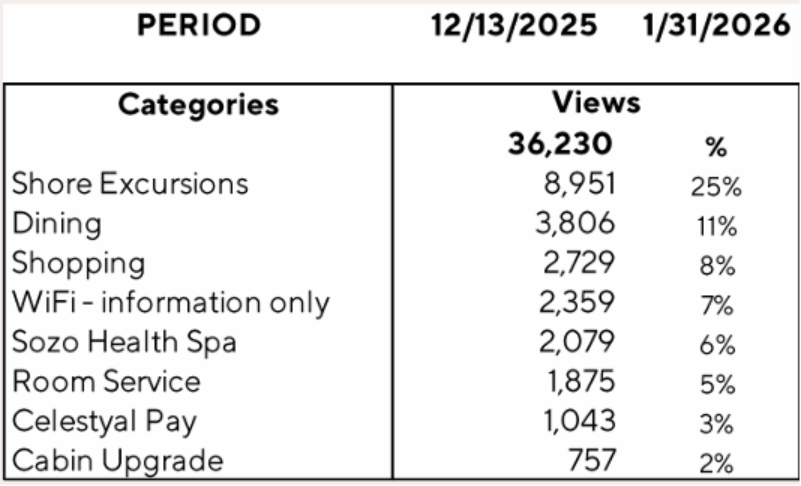
The average usage per session was just over four minutes.
For Celestyal, SuitePad is not just a digital replacement for paper. It is a way to bring structure, clarity, and engagement to a complex onboard environment – supporting both the guest experience and operational efficiency.
Comments (0)
There are currently no comments about this article.
To post a comment, please login or subscribe.