
Articles
| Name | Author | |
|---|---|---|
| From Hotels To The High Seas: Digitizing Passenger Experience At Celestyal | Celestyal and SuitePad | View article |
| Introducing: Lufthansa Industry Solutions’ Digital Twin | Dr. Gerald Däuble, Head of LHIND Digital Twin | View article |
| Ultrabulk Realizes The Human Dividend | Oskar Fabricius, CFO at Ultrabulk | View article |
| A Shipping Business Made Savings And Improved Utilization | Amanda Aho Vanhatapio, Customer Success Manager, Seaber | View article |
| The Changing Maritime Sector | Callum Beaumont, Founder of Cordell Beaumont | View article |
| Keeping It All together For Ambassador Cruise Line | Ryan Simpson, Head of Technology, Ambassador Cruise Line | View article |
| Seacraft IT Takes To The Oceans | Ed Haskey, Director Aircraft IT | View article |
Introducing: Lufthansa Industry Solutions’ Digital Twin
Author: Dr. Gerald Däuble, Head of LHIND Digital Twin
Subscribe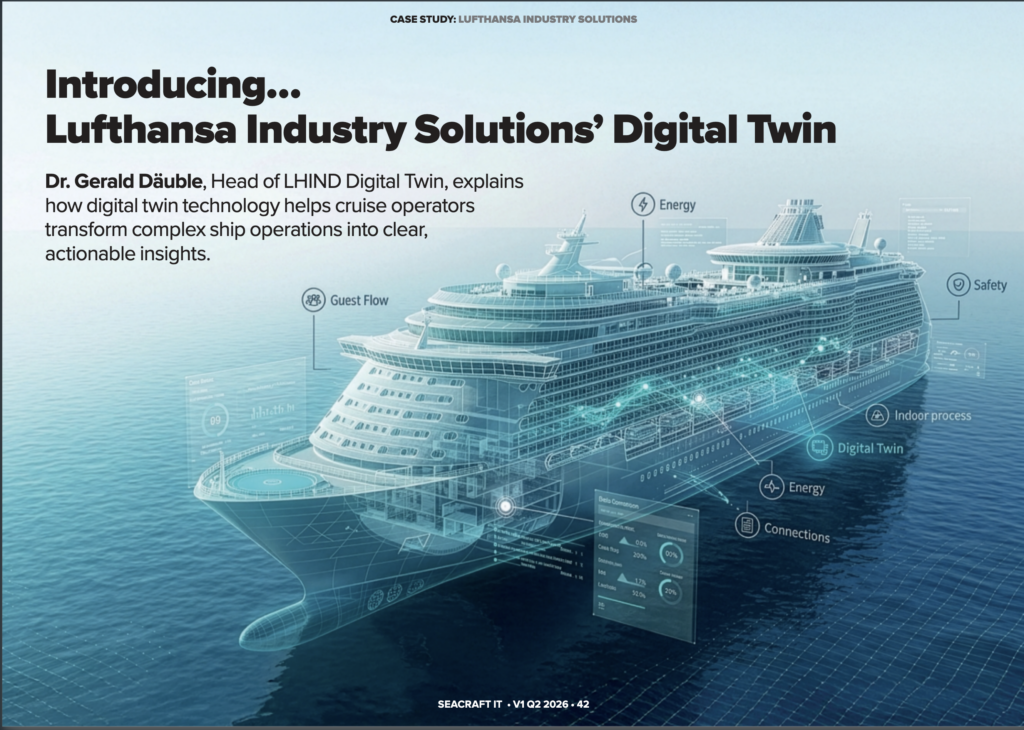
Dr. Gerald Däuble, Head of LHIND Digital Twin, explains how digital twin technology helps cruise operators transform complex ship operations into clear, actionable insights.
Before we go into the main subject of this article, our Digital Twin, I’d like to start by briefly, telling readers about Lufthansa Industry Solutions, what we do and our solutions for the maritime sector as well as part of our established portfolio of solutions, including those for industry and aviation.
LUFTHANSA INDUSTRY SOLUTIONS
Lufthansa Industry Solutions (LHIND) is an IT consulting and system integration company that drives digital transformation across a wide range of industries. As a subsidiary of the Lufthansa Group, we support both internal and external clients spanning more than 300 companies in various sectors. Headquartered in Norderstedt, Germany, Lufthansa Industry Solutions employs more than 3,000 specialists across Germany, Albania, Switzerland, and the United States.
We bring over two decades of project experience in the maritime sector, supporting cruise lines, shipyards, and maritime operators worldwide in building resilient digital capabilities and modern IT operating models. Lufthansa Industry Solutions’ maritime portfolio combines highly available IT infrastructures with advanced digital solutions tailored to ship operations. To an increasing degree, we are enhancing these foundations with AI applications to improve efficiency, transparency, and operational safety, all aligned with practical onboard realities. Our aviation experience also informs our approach, particularly in operational reliability, safety, and seamless passenger experiences.
CHALLENGES FOR THE MARITIME SECTOR
As well as designing solutions for today’s maritime sector, we also have to think about what challenges will be facing the sector in the next few years. There are several key issues that will face maritime operations in the next few years: delivering a consistently high and personalized guest experience, ensuring operational efficiency, and integrating complex IT systems effectively. Industry data from the Cruise Lines International Association (CLIA) shows that the growing numbers of first-time and younger cruisers, as well as multi-generational travel patterns, are increasing expectations for seamless digital services and individualized onboard experiences.
What was once addressed through broad passenger segments is now evolving towards hyper-personalization and data-driven touchpoint optimization. Operational reliability, transparency, and service continuity are decisive factors, supported by stable IT systems, high-quality data, and tightly integrated ship-to-shore processes. Sustainability requirements continue to influence planning, investment priorities, and operational frameworks across the industry and we have developed a number of products at Lufthansa Industry Solutions to meet those challenges.
PRODUCTS FOR THE MARITIME SECTOR
With reliable onboard networks, resilient communication structures and secure ship-to-shore connectivity, we form the foundation for digital ship operations. Building on this infrastructure, Lufthansa Industry Solutions provides integrated digital solutions connecting ship systems, operational workflows, and guest services within a governed data environment. At the core of our portfolio is the Lufthansa Industry Solutions’ Digital Twin, which serves as an operational interaction layer across onboard domains. It enables transparency, cross-system coordination, and data-driven decision-making in complex ship environments.
Complementing this, we offer guest-facing and process optimization solutions, including digital boarding for faster check-in, efficient cabin management for personalized comfort, and AI-supported applications such as food waste reduction. Across all offerings, the goal remains: translating operational complexity into measurable value for reliability, efficiency, enhanced guest experience, and sustainability.
We deliberately combine both adapting products already used in other sectors and developing maritime specific products. As a cross-industry technology partner, Lufthansa Industry Solutions transfers proven solution concepts, from aviation, logistics, retail, security, and manufacturing, into maritime environments where reliability, safety, and uninterrupted operations are equally critical. At the same time, we develop maritime-specific solutions addressing unique onboard conditions such as connectivity constraints, heterogeneous system landscapes, and tightly coupled operational workflows. Customers benefit from this dual approach: cross-industry innovation combined with deep maritime adaptation, refined through more than twenty years of cruise and maritime delivery experience.
One development that has key applications in the maritime environment has been our digital twin and here’s how the Lufthansa Industry Solutions Digital Twin supports operational decision-making across the maritime sector, and where it can be applied beyond cruise operations.
LUFTHANSA INDUSTRY SOLUTIONS DIGITAL TWIN
The concept of digital twins was established in the 1960s and the definition is quite broad. Maritime operations involve highly interconnected systems, distributed data sources, and complex, often time-critical decisions. The Digital Twin consolidates fragmented systems, processes, and sensor data into a single, interactive platform. Unlike conventional approaches, the Digital Twin deploys information along user thinking patterns and mental models, making complex relationships intuitive and accessible, even for non-data-savvy users – figure 1.
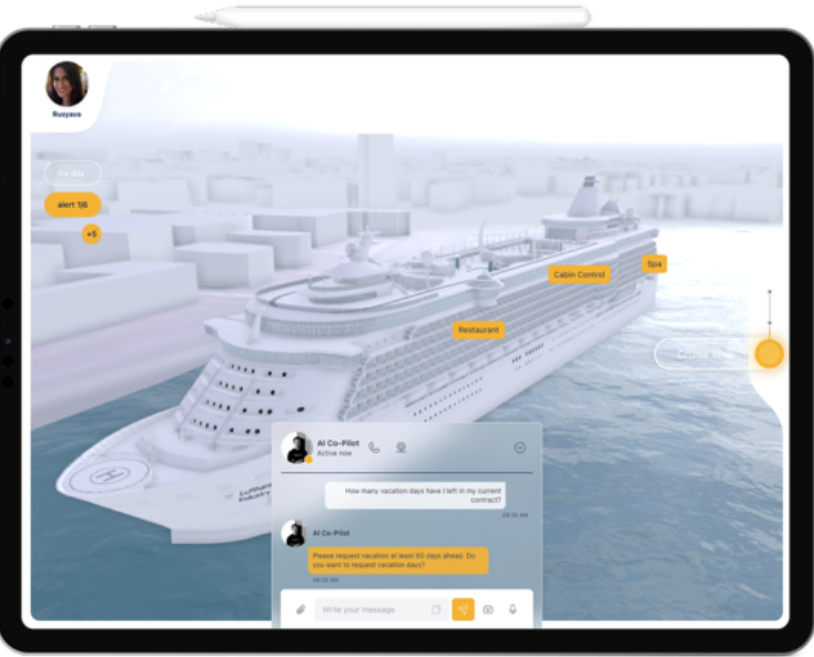
Figure 1: Digital Twin Ship View & Co-Pilot
This enables faster situational assessment, clearer prioritization, and informed, compliant, data-driven decisions – bridging the gap from insights to real operational impact. Applications range from capacity and demand management in restaurants, as seen in figure 2, or spa areas to optimizing guest flow in high-traffic zones and coordinating hospitality and technical services.
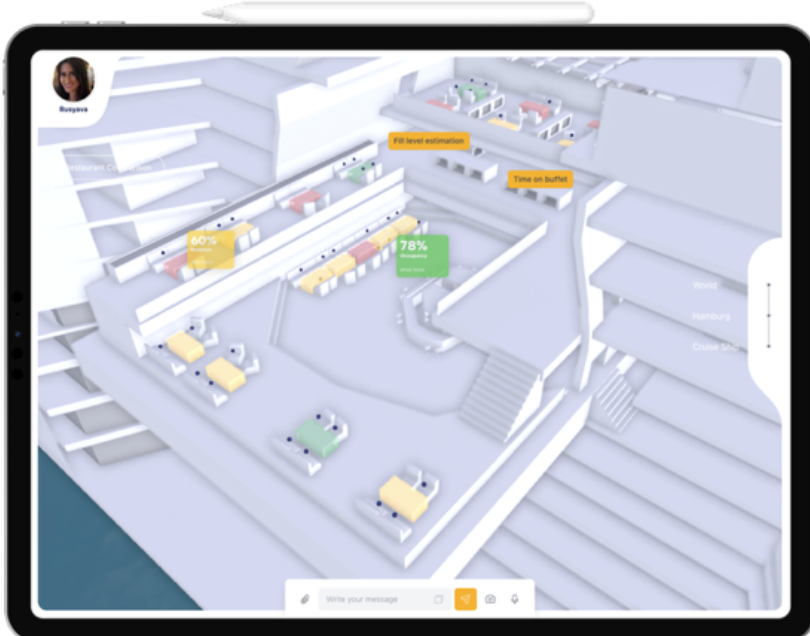
Figure 2: Digital Twin Restaurant Insights
In each case, the Digital Twin transforms operational complexity into actionable clarity: in short, it provides high-quality information to several users in their thinking pattern and mental model.
This results in:
- Efficient interaction with systems – independent of organizations and technologies;
- Uncovering ‘unknown unknowns’ and new patterns, relevant to operations;
- Multiple views and perspectives – one underlying platform integrating dozens of systems;
- Empowering non-data-savvy users through clear and intuitive information and state-of-the-art technology (snackable-data);
- Creating an Ecosystem for both today’s and tomorrow’s challenges.
The Lufthansa Industry Solutions Digital Twin is not limited to maritime environments. Its architecture is inherently cross-industry and already applied in aviation, retail, logistics, and manufacturing. Wherever operations depend on interconnected systems and time-critical decisions, the Digital Twin serves as an operational interaction layer – transferring proven operational logic across sectors and turning data into decisive action. Our ‘Man Overboard’ solution is a great example of a concrete safety use case.
APPLICATIONS FOR LUFTHANSA INDUSTRY SOLUTIONS’ DIGITAL TWIN
Lufthansa Industry Solutions’ Digital Twin is built for radical clarity which, in business, drives better decisions. In high-stakes situations like a man-overboard incident, the ability to understand complex information in a split second isn’t just useful – it can save lives. In emergency situations, two core tasks are critical: reliable and timely detection of ‘Man Overboard’ events, see figure 3, plus accurate localization and rescue of the person in distress.
In short: Rescue = Detection × Localization.
[[INSERT LHND SOLS FIGURE 3.png HERE]]
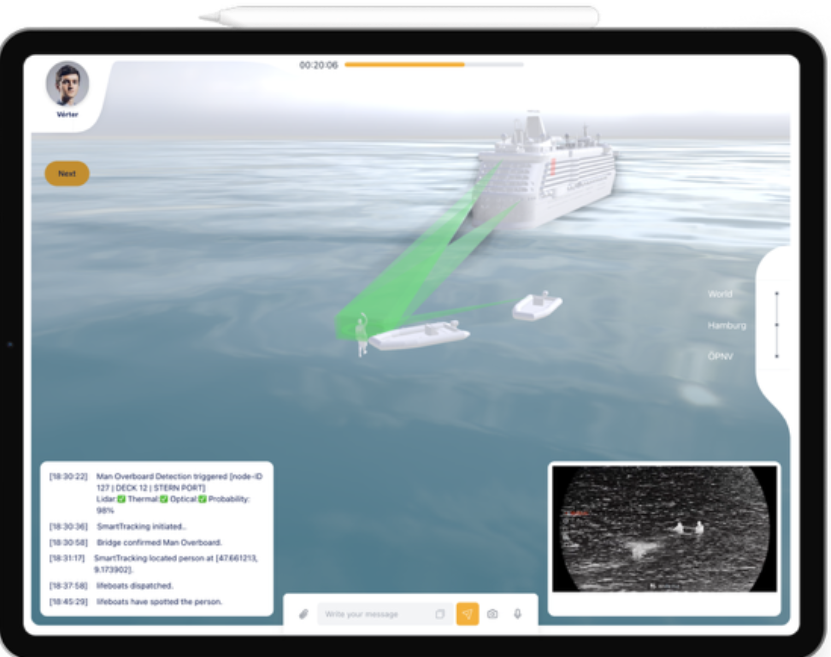
Figure 3: Man Overboard Detection and Localization
Current ‘Man Overboard’ detection systems often rely on outdated or basic technologies. This leads to two major problems: incidents go undetected altogether (false negatives), frequent false alarms reduce trust and often lead crews to disable the systems (false positives). In collaboration with HIKVISION and EW Production Services, we developed a Man Overboard Detection solution within the Lufthansa Industry Solutions Digital Twin. It significantly improves both ends of the spectrum through:
- Deployment of cutting-edge technologies (thermal and conventional imaging in fixed cameras and mobile binoculars, AI-based computer vision).
- Intelligent synchronization and combination of these systems.
- A clear, role-specific visualization for all stakeholders during an emergency.
For the first time, all relevant technologies are integrated into a single rescue system. And, even more important, all relevant technologies are manufactured in sync with hardware, software and network for uncompromising detection quality on the day of installation and also throughout the complete lifecycle. By connecting all systems into a single smart solution, we create a reliable real-time operational picture, the foundation for fast, informed decision-making. This innovation emerged from collaborative ideas and integrated ecosystems rather than individual technologies.
PARTNER STATEMENTS
Here are a couple of statements from partners of the Digital Twin.
“Delivering seamless, real-time detection across open decks, our Man Overboard Detection solution empowers crew to act instantly – maximizing the speed and success of passenger recovery while reinforcing the highest standards of onboard safety.”
Alan Kennett
Senior Solutions Specialist
Hikvision UK Ltd
“Our Digital Twin technology gives operators a real-time, data-driven view of their entire vessel, turning complex ship operations into clear, actionable insights. It enables faster decisions, reduced downtime, and a smarter, safer way of running modern fleets. With powerful data integration and live operational insight, our Digital Twin accelerates decision-making and unlocks new efficiency – strengthening reliability, enhancing safety, and reinforcing the innovation promise behind every voyage.”
Paul Byrne
Managing Director
EW Production Services LTD
X-RAY VIEWS AND FLEET COMPARISONS
The LHIND Digital Twin’s X-Ray View enables operators to explore ship operations at different levels of detail from ship‘s overviews down to individual systems or cabins, as in figure 4.
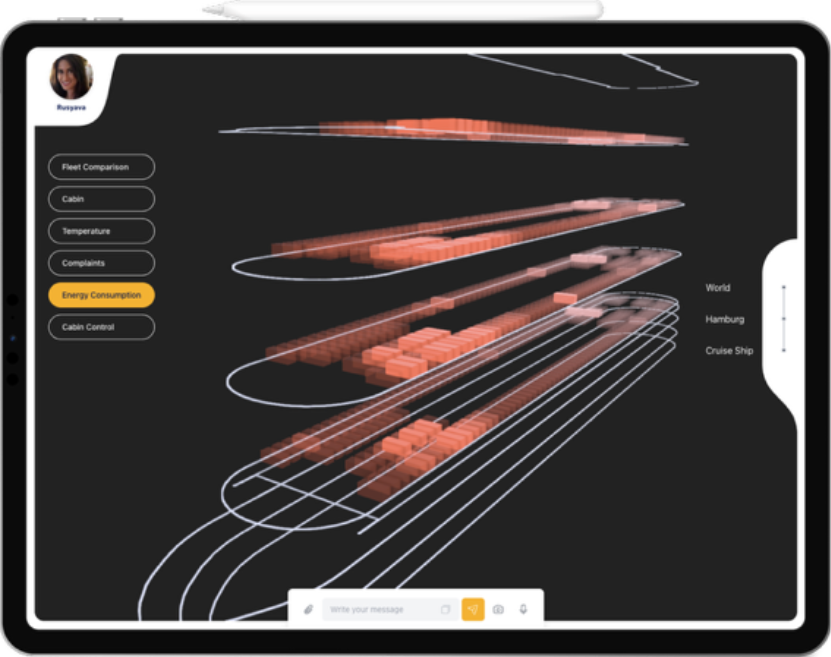
Figure 4: Digital Twin X-Ray View
We think in layers, like incidents, energy consumption, passenger claims, etc. Data from several sources can be combined into relevant insights at a glance. One platform – multiple perspectives and users: information is tailored to specific users – on ship and on shore. Cruise lines benefit from fleet-wide insights, patterns, optimizations, and organizational learning – figure 5.
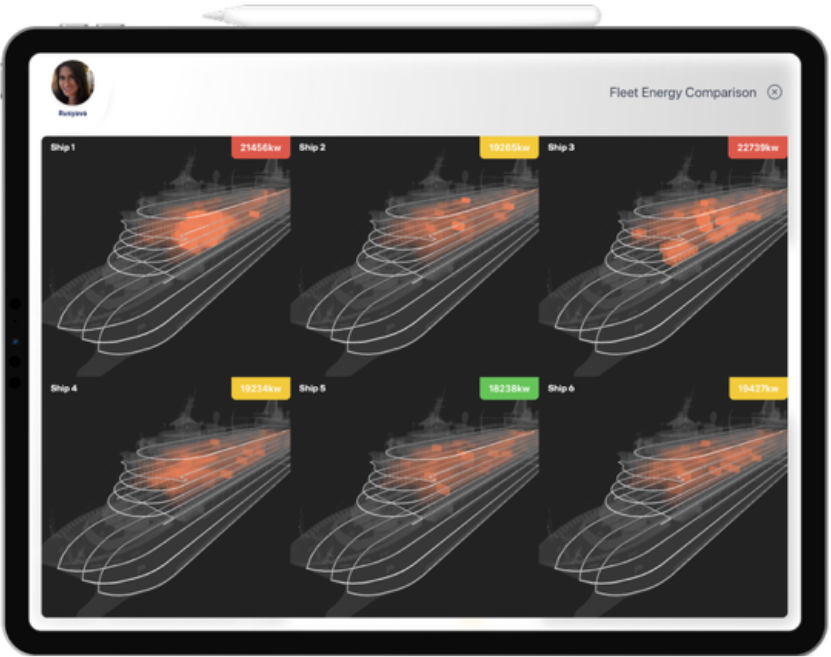
Figure 5: Digital Twin Fleet Comparison
IN CONCLUSION
As cruise ships evolve into highly connected operational environments, the ability to understand and manage complexity becomes increasingly important. The LHIND Digital Twin transforms fragmented system data into a unified operational view, enabling faster decisions, improved efficiency, and better coordination between ship and shore teams.
An entire ship is essentially its own digital ecosystem.
By making this ecosystem transparent and actionable, the LHIND Digital Twin helps operators move from isolated data points to meaningful operational insight. Strengthening reliability, sustainability, and guest experience across modern maritime operations.
Comments (0)
There are currently no comments about this article.
To post a comment, please login or subscribe.