
Articles
| Name | Author | |
|---|---|---|
| From Hotels To The High Seas: Digitizing Passenger Experience At Celestyal | Celestyal and SuitePad | View article |
| Introducing: Lufthansa Industry Solutions’ Digital Twin | Dr. Gerald Däuble, Head of LHIND Digital Twin | View article |
| Ultrabulk Realizes The Human Dividend | Oskar Fabricius, CFO at Ultrabulk | View article |
| A Shipping Business Made Savings And Improved Utilization | Amanda Aho Vanhatapio, Customer Success Manager, Seaber | View article |
| The Changing Maritime Sector | Callum Beaumont, Founder of Cordell Beaumont | View article |
| Keeping It All together For Ambassador Cruise Line | Ryan Simpson, Head of Technology, Ambassador Cruise Line | View article |
| Seacraft IT Takes To The Oceans | Ed Haskey, Director Aircraft IT | View article |
Ultrabulk Realizes The Human Dividend
Author: Oskar Fabricius, CFO at Ultrabulk
Subscribe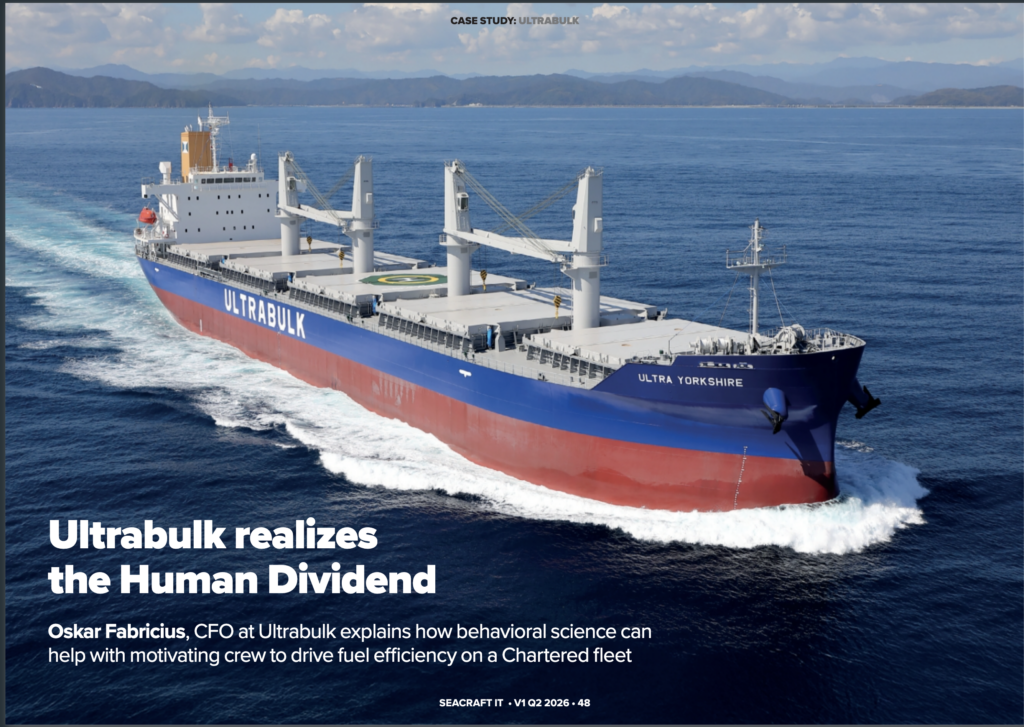
Oskar Fabricius, CFO at Ultrabulk explains how behavioral science can help with motivating crew to drive fuel efficiency on a Chartered fleet
Before looking at the main subject of this article – which is what behavioral science has done for Ultrabulk and our crews – let me first introduce ourselves.
ULTRABULK
Ultrabulk is a global dry bulk operator with anywhere between 160 to 200 vessels in service at any time. Our fleet ranges in size from Panamax, Supramax, and Handysize vessels, to smaller MPPs down to around 12,000 tons deadweight. Our operating model is predominantly based on chartering vessels from owners and using those vessels to supply services to our cargo owners; we don’t own our vessels, which means the crews onboard the vessels do not report to us.
The cargoes we transport vary, but they are mainly grains, sugar, minerals, ores, and coal. These account for about 55 percent of what we transport, while the rest is a mix of fertilizers, forestry products, construction materials, iron ore, salt, and steel. In addition, we carry project cargoes such as windmill blades, steel plates, and other odd-size items.
REASONS TO IMPLEMENT A FUEL EFFICIENCY SOLUTION
Nearly six years ago, we established a fuel efficiency team. It began very simple: we wanted to understand how much fuel the ships were consuming as a first step toward understanding the baseline we could improve from. Since then, we have focused our fuel management efforts on every variable except the crew on board. We hired technical experts and focused on finding the optimal ways to run a ship – including the best use of the main engine and knowing when an auxiliary engine needs to be engaged. We have also examined draft, trim and LED lighting as well as tested and implemented different ESDs (energy saving devices). We have of course also been interacting with the crew, but mostly on an instructional basis and not focusing on how to get them onboard with the journey.
We have been working closely with the people around us, including our owners, technical managers, and customers, with a significant focus on data, automation, technology and ESDs. We have made good progress in many instances, but we were still missing something. You can implement all of these technical changes, but if you forget that you are working with people, then at some point, your incremental improvements will cease. The challenge is: how do you motivate people onboard to prioritize fuel efficiency?
We had many good ideas, but we needed to engage the crews. We cannot demand much of them because we are not their employer. We occupy a position of influence without authority. So, we needed to find a way to motivate crews to do these things simply because it is the right thing to do. This was one of the biggest challenges for us and that is why we found the Signol approach interesting.
ORDERING NEW SHIPS IS NOT THE ONLY ANSWER
If we can improve the performance of the current fleet, the impact is greater. If we rely only on ordering new environmentally friendly ships to improve fuel savings and emissions, we are only going to see the full effect in 30 years. There are over 20,000 ships already on the water, and they are not going to disappear overnight. While taking advantage of modern tonnage is part of what we do, we also have a strategic focus on getting the most out of the available vessels already in the global fleet.
THE SIGNOL SOLUTION
A certain amount of data has to be supplied, and data pipelines must be set up, but once that initial work has been done, the system works autonomously. In this test phase with Signol, having high-quality data was key, because without data, you can’t prove anything. The implementation has been a good experience and quite easy, and our collaboration with Signol has been really positive.
Signol provides dashboards for us to monitor real-time. It does not interfere with our technical strategy. Instead, we choose our company focus areas, and Signol interacts with the crew based on behavioral science to engage and motivate them to focus on those same goals. The system essentially supports our existing efforts through positive reinforcement. Furthermore, it brings the people on the ships together with the people on shore, working toward a shared goal to save fuel and help the environment. We were trying to create that alignment on our own, but this does it better.
SETTING GOALS
The first step is for all parties to agree on the focus area, such as auxiliary engine fuel consumption. Then, goals are set that make sense for a particular crew and vessel in light of their historical data. Signol has a smart way of setting the right goals based on the crew’s own historical performance. For a top-performing crew, a fleet-average goal is a waste of time; for a crew facing more challenges, that same average can feel unattainable. Once the goal is set, Signol gives updates to the crew to follow their own progress.
FITTING WITH ULTRABULK PROCESSES
Signol was the right fit at the right time for us. You have to have your house in order, including the necessary data and a clear agreement on the processes you want to improve. The biggest challenge was that we don’t own our vessels, so we had to convince third parties to take part. We worked with Signol to convince technical managers, owners, and captains. Even if you own the ships, you still need buy-in from the people on board.
In the beginning, you need close cooperation to focus on the ships where it is difficult to get started. We solved that together; we spoke to these counterparties with Signol’s support and adjusted the messaging to ensure the crews understood how things were connected. We insisted on having a control fleet for the test, because we wanted to be sure we could prove whether it was working or not. Comparing like-for-like is important because you don’t want to complete a trial and then be unable to prove if the service produced a real impact.
IMPLEMENTATION AND FIRST USES
We started around the 1st of February 2025 and trialed seven ships, with a control fleet of seven monitored ships. We dedicated an operator who understood the ships and operational challenges to be the contact point for the trial. He coordinated with other departments, including data and technical teams, and I also had the chance to be involved during this period.
The behavior we focused on was efficient auxiliary engine usage, and we also looked at the boiler, draft, and to some extent, the main engine. We saw the clearest behavioral change in auxiliary engine usage, where there was a clear improvement in performance both at sea and in port. While we saw some improvement with the boiler, it was less significant. The auxiliary engine is where it is easiest to separate performance from other variables. We could see a tangible improvement in fuel efficiency – one that was significant enough to continue.
WORKING WITH SIGNOL
Crew feedback has been that Signol is easy to use. It is intuitive and simple, which is important because people on ships are very busy and face a lot of documentation.
Our cooperation with Signol has been strong. You can discuss exactly what you want to test, but it is important to be clear about where you have the best chance to prove a change in your environment. The control group is vital; when spending money on new solutions, you need to demonstrate why they make sense. Without the control group, we likely would not have been able to justify the rollout. The control group was the basis for the business case; we told our performance team they could focus as much as they wanted on the control group to see what they could achieve, which gave us a clear way to see the improvement.
FUTURE PLANS
We are now taking the next step. Having started with seven vessels, we are rolling the solution out to a larger part of the fleet while still keeping a significant control group to ensure it delivers long-term benefits at the level we have seen so far.
For me, the most important thing about Signol is that it is easy. You don’t have to take a ship into dry dock or make physical changes to the vessel. If you already have a good way of working, you can put Signol on top and it will likely make a good thing better. It is simple to use and works autonomously once aligned. In brief, it’s efficient and doesn’t get in the way of sailing the ships.
Comments (0)
There are currently no comments about this article.
To post a comment, please login or subscribe.